
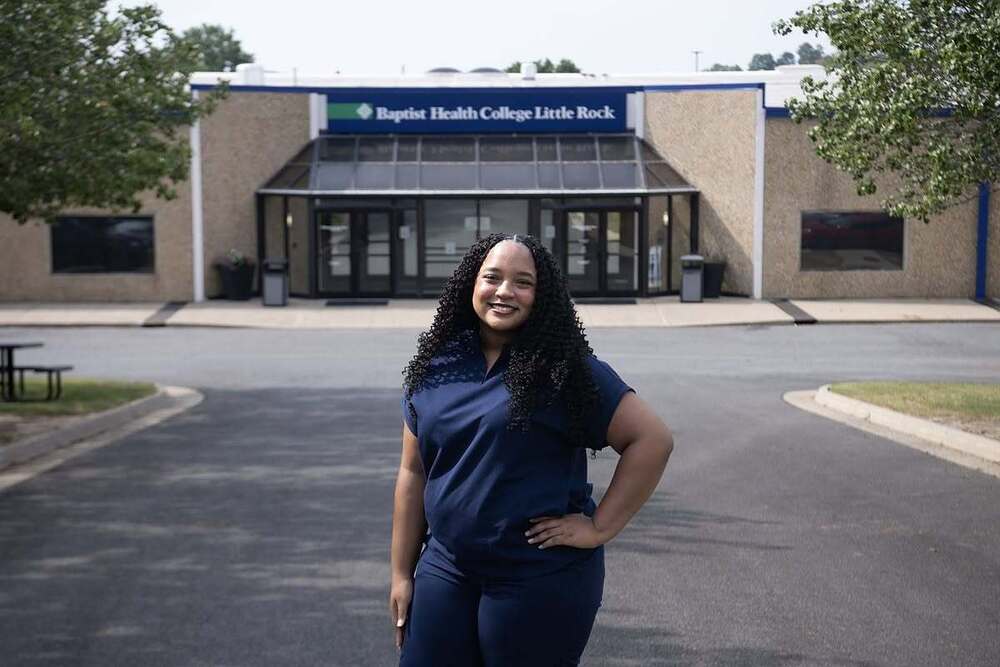
Article by: Anne Li of the Arkansas Democrat-Gazette
Photo by: Adam Vogler
Karis Wesson remembers clearly the struggle of learning to insert an IV on a mannequin arm.
Wesson's classmates in her practical nursing program at the Little Rock School District seemed to master the skill easily, and she could feel herself getting frustrated. But when her teacher noticed and stopped to give her one-on-one training, it calmed her down and gave her "confidence that I didn't even realize I needed," she said.
"I'm very thankful for (my teacher) for that moment," Wesson said.
In June, Wesson, 18, graduated with both a diploma from Central High School and the credentials to become a licensed practical nurse, or LPN. She is now working as an LPN in an assisted living facility and taking prerequisites for a program to become a registered nurse at the University of Arkansas at Little Rock.
Wesson and six others comprised the first cohort in the Little Rock School District's LPN training program, offered at the district's Metropolitan Career-Technical Center, or Metro, through a partnership with Baptist Health College Little Rock.
Of the seven graduates, two were from Central, according to Shameka Montgomery, the district's director of career education at Metro. Hall and Parkview high schools had one student each, and the remaining three were non-Little Rock School District students.
Metro provides career and technical education to high school students in the Little Rock area, offering programs in health sciences, information technology, skilled trades and more. Any student in grades 10-12 in Pulaski County is eligible, including charter school and homeschooled students, according to the Metro website.
Many Metro programs, like the LPN program, allow students to earn professional certifications, the website says. Little Rock School District students can schedule classes at Metro through their guidance counselor, according to the website; others must fill out an online application.
Metro's LPN students' tuition fees at Baptist Health College Little Rock are covered by grant money from the Arkansas Department of Commerce's Office of Skills Development and "vocational center aid" from the state.
Students enter the program as rising juniors in high school and, over the course of two years, take every class required of a traditional LPN student, including concurrent college coursework in anatomy and physiology. They also complete clinicals at Baptist Health, often staying late into the night.
In addition to coursework and clinicals, the students participate in paid summer internships at Baptist Hospital, supported by Little Rock's Summer Youth Employment program, where they shadow real-life healthcare professionals.
At the conclusion of the program, the students take the practical nursing licensure exam for free, Montgomery said.
Those exams serve as one measure of the program's success. All seven students in the first cohort passed the exam; all are pursuing higher education in healthcare, Montgomery said, and all but one have stayed in state.
"For this program, we wanted to increase the healthcare workforce, expand college access for our students and remove any financial barriers," Montgomery said.
Licensed practical nurses provide "direct patient bedside care such as personal hygiene, treatments and medication administration" under a registered nurse's supervision, according to Baptist Health College Little Rock's website.
According to Montgomery, 10 students are now beginning their third semester of the LPN program and will graduate this coming June. Fourteen more are beginning their first semester and hope to graduate two years from now.
The district's LPN program started with an email from the director of the state Office of Skills Development, looking for career centers like Metro to pilot such a program.
"We were interested in doing more to support the workforce and healthcare," Montgomery said. "We started thinking about how we could implement a program like this in the Central Arkansas area for our students."
Working with Baptist was a "no-brainer," she added.
Wesson has always been drawn to healthcare, but participating in the program helped her "discover and build that passion," she said. Her favorite classes covered maternity, obstetrics and pediatrics, and the program gave her the chance to work in neonatal intensive care, labor and delivery, and postpartum care. She hopes in the future to work with women and children.
Montgomery, who's been in her role for 11 years, remembers the pride she felt at June's "pinning ceremony" and graduation.
A pinning ceremony is a tradition in nursing education that dates back to the 1860s, according to the American Association of Colleges of Nursing, when Florence Nightingale -- considered the founder of modern nursing -- was recognized for her service during the Crimean War. The ceremony typically involves faculty placing a pin or ribbon on each student's lapel as they say a pledge.
"I was proud ... for each student that graduated. I was proud for the families who were impacted," Montgomery said. "And I was also very proud of the work that my team and I did to make this program happen."